Jane Glasson
Panic RoomJane Glasson is the missing daughter whose disappearance becomes a long-running mystery, but the later discovery that she is living under the name Astrid Townsend deepens rather than settles the question. Once a Cambridge student and the closest friend of Holly Walsh, she vanishes on a journey from London to Cornwall in June 1996. Years later, she is found to have worked for more than two decades as a confidential specialist connected to Filippo Crosetti and Harkness Pharmaceuticals. Her refusal to acknowledge her former identity, followed by her decisive intervention over Cascade, leaves the reasons for her disappearance and the full nature of her work unresolved.
Identity and Background
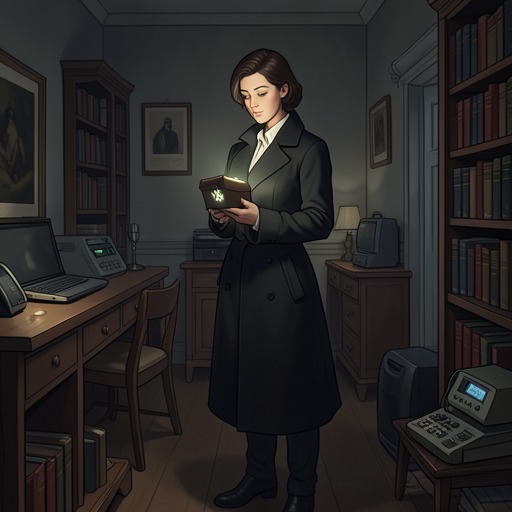
Jane is introduced to Don Challenor through a faded photograph on a glass-topped wicker table at her father Andrew Glasson’s home. The small silver-framed picture shows Jane and her sister Muriel as fair-haired girls in their early teens. They resemble one another, though Jane appears younger and is distinguished by high cheekbones and large eyes. Andrew identifies her as the girl on the right. A second photograph, taken by Holly on Jane’s twenty-first birthday during a punt trip along the Backs, presents an older Jane in a cheesecloth blouse and jeans. Her hair is darker, and the image gives Don an impression of maturity and unknowability. The photographs preserve different versions of her, but neither explains the break between the daughter Andrew remembers and the woman who later rejects that name.
Jane was Holly’s best friend first at boarding school and then at Cambridge. Their plans included meeting again in Cornwall at the beginning of September, after each had earned spending money. Holly recalls their last day together as ordinary: they had coffee at King’s Cross, talked, and parted to take the Underground in different directions. Jane had recently ended a relationship with a student at King’s, a subject Holly teased her about. Nothing in their conversation suggested a planned departure or a final meeting. Holly’s recollection makes the disappearance more unsettling precisely because it offers no warning sign to explain it.
Disappearance and the Unanswered Search
Jane had completed her second year at Cambridge when she and Holly travelled to London at the end of term. At King’s Cross, Jane said she would take the Tube to Paddington and catch a train to Cornwall. Andrew drove to Camborne to meet her, but she was not on the train; as far as the family could determine, she had never boarded it. At first he expected a misunderstanding and thought she might arrive on a later train. When she did not, the uncertainty became the defining fact of the search. Jane disappeared in June 1996, and Andrew says that the not knowing destroyed his wife, although not in any official sense.
Holly was effectively the last person known to have seen Jane before she vanished. Afterward, she met with Andrew and his wife several times and tried to help, but she had no explanation to offer. She was as surprised as Jane’s other friends. Much later, when Don asks about the day, Holly again insists that everything had seemed normal. She cannot say what happened after they separated, and she believes that the family may never learn the answer. Her acceptance is not certainty: it is an attempt to live with a loss whose cause and outcome remain beyond her knowledge.
Andrew’s hope that Jane might still be alive is entangled with his effort to obtain certainty by consulting Wynsum Fry, a seer whom Blake had suggested. Blake had privately believed Jane was probably dead but did not tell Andrew, preferring not to extinguish his hope. When Holly’s medical treatment is known to have an anonymous benefactor, Blake wonders whether Jane could be responsible; she recognizes that this is speculation, not proof. Holly likewise rejects the idea that a fortune-teller’s prediction establishes Jane’s fate. She cannot imagine Jane deliberately subjecting her parents or her closest friend to decades of uncertainty, and says there was nothing in their final day that suggested a plan to disappear.
Reports That Jane Is Alive
Gareth Lawler later tells Don that he saw Jane in Paddington. At first he could not believe the woman before him was the person he remembered, but he says that once he saw her face he recognized her. She was older, yet, in his view, essentially unchanged. Gareth reports that Jane recognized him too; before he could speak, their eyes met, and he understood that she intended to deny being Jane. He remains certain despite having no evidence he can give Andrew. He tells Don that Jane is alive and does not want anyone to know it, while acknowledging that he cannot prove the claim to her father.
The corporate records offer a separate and more concrete lead. A review of Harkness Pharmaceuticals’ human-resources files finds only one retained specialist contractor whose service extended beyond five years. Contractor 55 is described as a forty-six-year-old British woman attached to Crosetti’s staff. The company refuses to provide personal details because Crosetti requires absolute confidentiality for specialists he recruits himself and supervises at the research facility in Locarno. The records therefore conceal the person behind the number while also narrowing the search. Ingrid Denner plans to question Crosetti about the contractor at a meeting in Zug on 14 June, and Blake recognizes that the meeting is only two days away.
Blake eventually identifies contractor 55 as Jane. The discovery links the missing student to a professional life at Harkness Pharmaceuticals that has continued under a protected identity. On a tram in Zürich, Blake overhears Jane speaking by phone with Crosetti. Jane describes an accident she has heard and says she walked away rather than become involved; she also discusses keeping a woman a priority, where that woman is being housed, and an upcoming meeting. The call connects Jane to Crosetti and to the company’s internal affairs, but it does not explain why she left her earlier life or what name she used in it. The company file and the overheard conversation reveal a position inside the organization, not the history behind it.
Astrid Townsend and the Refusal of Recognition
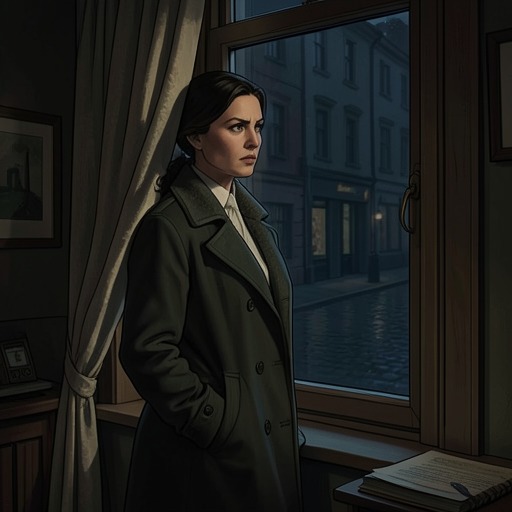
When Blake confronts the woman she believes to be Jane, the woman gives her name as Astrid Townsend and says she can prove it. Blake answers that she can prove the woman is Jane Glasson. Rather than offer an explanation, Astrid asks why Blake would want to establish that. The exchange shifts the problem from recognition to choice: Jane’s apparent identity is no longer merely a secret to be uncovered, but one she actively refuses to reclaim in public.
In front of Ingrid, Jane allows Blake to present the case, while making clear that the conclusion will make no difference to her. When Ingrid asks directly, Jane categorically denies being Jane Glasson and maintains that she has always been Astrid Townsend. Her controlled denial is complicated by small signs of communication with Crosetti. When her phone rings, she checks the screen and puts it away; Blake notices a change in her expression, and Crosetti appears to want to speak. Jane gives him a slight shake of the head and a faint reassuring smile. The moment suggests a private understanding between them, but does not disclose what the message says or why it matters.
Jane’s connection to Crosetti reaches beyond confidential employment. Blake identifies him as the creator of Elixtris, and Jane discusses biochemical or bioelectronic possibilities while the group examines what she has been working on with Harkness. She does not confirm that the work has continued throughout the twenty-two years since her disappearance. Instead, she redirects the conversation toward Blake’s claim about her identity. The scene establishes Jane as informed and professionally involved, while leaving the precise scope and purpose of her research unclear.
The Cascade Crisis and Narrative Significance
During the confrontation, Ingrid says she wants to know more about Jack Harkness’s activities and mentions her suspicion that he had Blake plant a bug on her laptop. Jane suddenly stands, takes out her phone, and urges Ingrid to ask Blake about the matter. She then checks the screen, presses a button, and hurries toward Harkness’s desk. A steel-shuttered screen descends between Jane and the others, leaving her on the far side with the desk and computer. The rapid separation turns a dispute over her identity into an immediate physical barrier, and prevents the others from reaching her.
Crosetti explains that the phone call must have been a message from Jack. He says Jane has sealed herself in with Harkness’s computer to stop him from operating the override for Cascade. This gives her action a clear, urgent purpose, but the evidence here does not establish what happens next or why she chooses to protect access to the computer in this way. The woman who spent years outside her family’s reach is now revealed as a consequential participant in the company’s crisis, acting decisively while still withholding her past.
Jane’s story is built around competing forms of evidence: photographs preserved by those who miss her, Holly’s memory of an unremarkable farewell, Gareth’s certainty that he saw her, and company records that identify her only by a contractor number. Each offers a piece of recognition, but none makes her explain herself. Her chosen name, her denial, and her continued secrecy keep the disappearance unresolved even after her survival becomes apparent. At the same time, her intervention over Cascade shows that she is not simply an object of other people’s search: she has agency in the present, and her actions affect the outcome of a danger larger than the mystery of her identity.